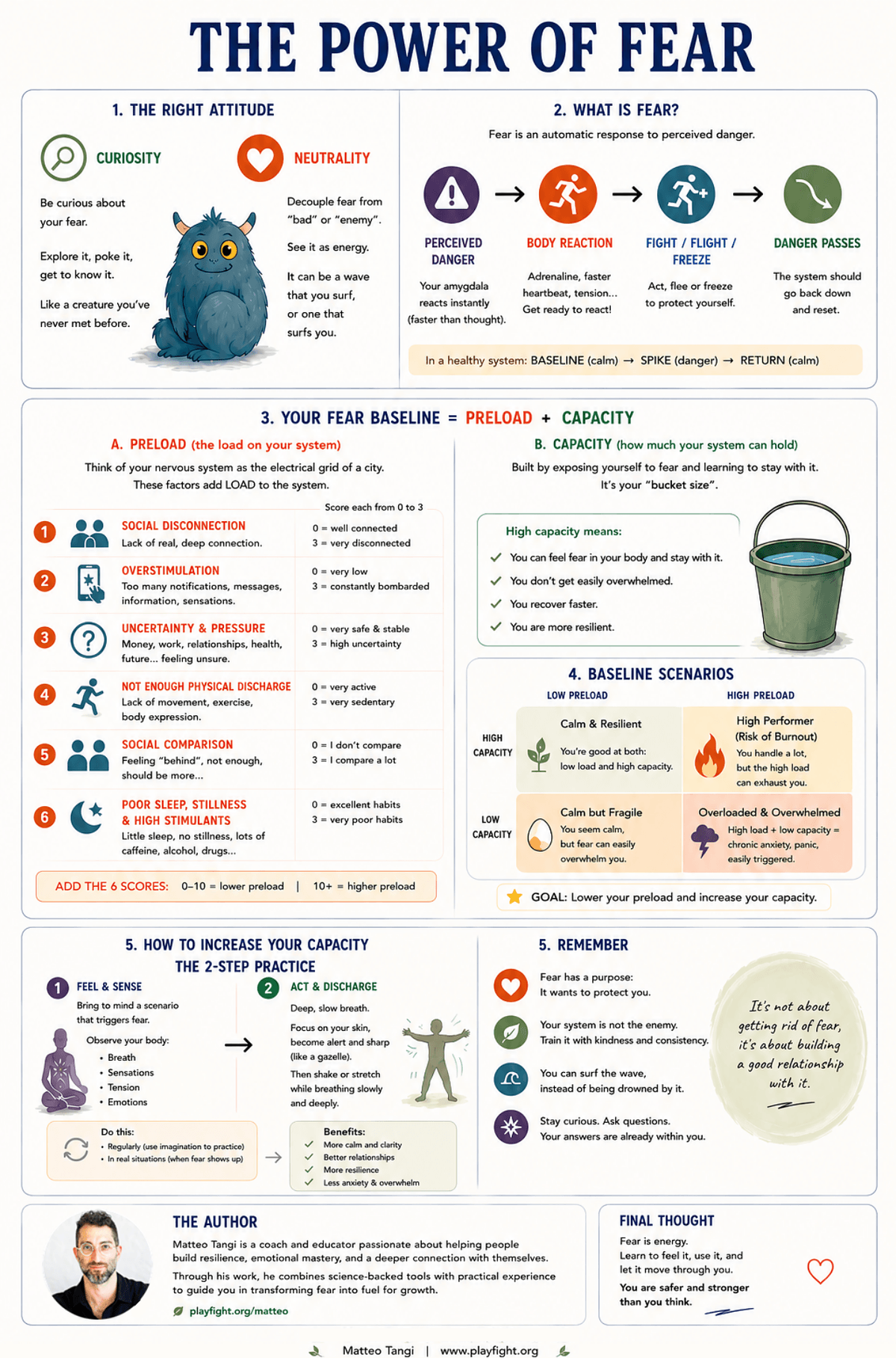
Abstract
Fear is not the enemy, it is a natural nervous system response designed to protect us. Anxiety, stress, insecurity, and overwhelm are often signs that our internal “baseline” is overloaded, not that something is wrong with us. By understanding preload and capacity, and by working with the body instead of against it, we can build resilience, emotional regulation, and the ability to stay open even in moments of intensity. Practices like Playfight help people develop a healthier relationship with fear through movement, breath, connection, and embodied awareness.
One of the most common responses I hear when I invite people to Playfight is simple:
“No… I’m afraid.”
And honestly, it makes complete sense.
For many years I believed the goal was to become fearless. I thought strength meant being unaffected, calm no matter what happened, untouched by discomfort or vulnerability. Over time I realized something very different. A healthy nervous system is not a system without fear, it’s a system that feels fear and can return to calm.
This understanding transformed the way I relate to emotions, relationships, conflict, and also to Playfight itself. When people wrestle in Playfight, what often appears first is not strength, confidence, or power. What appears first is fear: fear of losing, fear of being hurt, fear of hurting someone else, fear of looking weak, fear of intensity, fear of closeness, fear of being fully seen.
And what fascinates me is that fear itself is usually not the problem.
The problem is that many of us never learned how to regulate fear or work with it in a healthy way.

Fear Is Not Your Enemy
One of the first things I invite people to do is to stop seeing fear as something “bad” or something that needs to be eliminated.
Fear is energy, a deeply intelligent energy, and its role is protection.
Your nervous system is constantly scanning for danger and preparing your body to respond. This process happens automatically and often below conscious awareness. Sometimes this response is useful and life-saving, and sometimes the system reacts to things that are not actually dangerous but are perceived as dangerous, such as rejection, uncertainty, conflict, failure, loneliness, shame, or instability.
And the body reacts as if survival is at stake.
This is why fear is not just mental. You can think positively and still feel your body contract. You can logically know that something is safe while your nervous system continues reacting as if danger is present.
You can feel fear physically through shallow breathing, tension in the jaw, tight shoulders, accelerated thoughts, sweating, inability to relax, or contraction in the belly and chest.
Fear lives in the body.
And because of this, working only through thinking often has limits. Insight can help, but the body also needs to be included in the healing process. Real transformation often happens when the nervous system experiences safety directly instead of only understanding it intellectually.
Understanding Your Baseline
To understand Fear I use a simple framework that helps explain why some people become overwhelmed more easily than others.
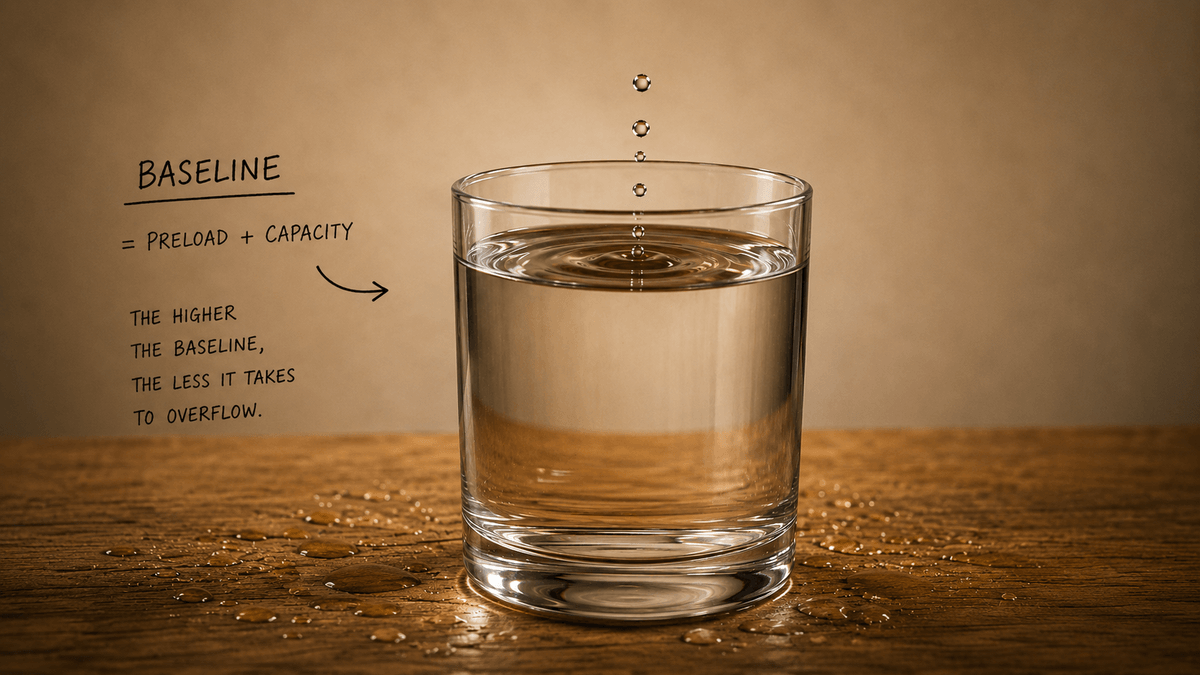
Baseline = Preload + Capacity
Your baseline is the level of activation your nervous system carries before something difficult even happens. It is the emotional and physiological state you are already living inside before stress arrives.
Some people already wake up tense, contracted, overloaded, and alert, while others begin the day feeling more spacious, rested, and grounded.
The higher the baseline, the less it takes for the nervous system to become overwhelmed.
Imagine a glass already almost full of water. Even one extra drop creates overflow.
That is often what anxiety feels like, not weakness, overflow.
When people judge themselves for being “too sensitive” or “too emotional,” they often ignore how much activation their system is already carrying. What looks like overreaction is frequently accumulated stress that has never had the chance to settle or discharge.
Your System Preload
Preload is how much stress, stimulation, pressure, or unresolved activation your system is already carrying before anything new happens.
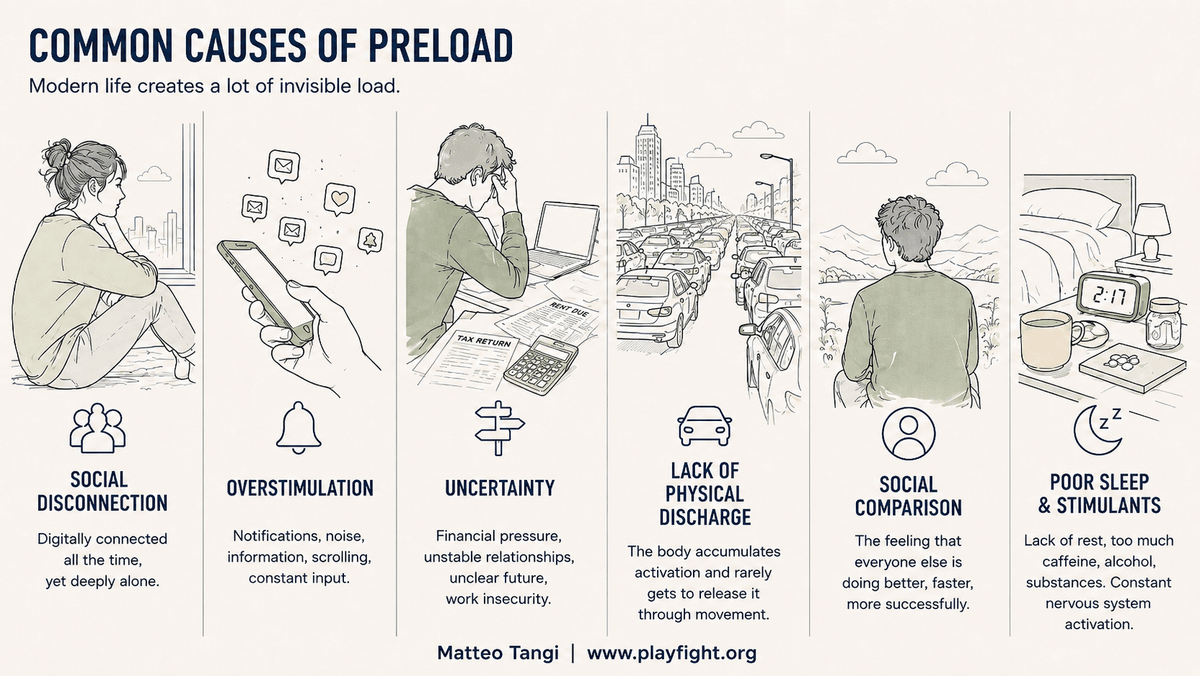
And modern life creates a lot of preload. Some common examples include:
1. Social Disconnection
We are digitally connected all the time, yet many people feel deeply alone. Human beings are wired for real connection, touch, eye contact, presence, and belonging. When those needs are missing, the nervous system often remains in a subtle state of stress and vigilance.
2. Overstimulation
Notifications, noise, information overload, scrolling, and constant input keep the nervous system activated. Many people rarely experience true silence or stillness anymore, and the body never fully gets the message that it can rest.
3. Uncertainty
Financial pressure, unstable relationships, unclear futures, and work insecurity create chronic stress. The nervous system struggles when it cannot predict what is coming next, and prolonged uncertainty slowly drains emotional resilience.
4. Lack of Physical Discharge
The body accumulates activation and rarely gets the chance to release it through movement and embodied expression. Stress hormones build up, tension stays trapped inside the muscles, and the nervous system remains partially activated even after the stressful moment has passed.
5. Social Comparison
The feeling that everyone else is doing better, faster, or more successfully creates pressure and inadequacy. Constant comparison can quietly reinforce anxiety, shame, and the belief that we are falling behind.
6. Poor Sleep and Stimulants
Lack of rest, too much caffeine, alcohol, substances, and constant nervous system activation reduce resilience over time. When the body is exhausted, even small challenges can feel overwhelming.
The important thing is not to judge yourself, the important thing is to become aware of what increases your load, because many people are not weak, their nervous system is overloaded.
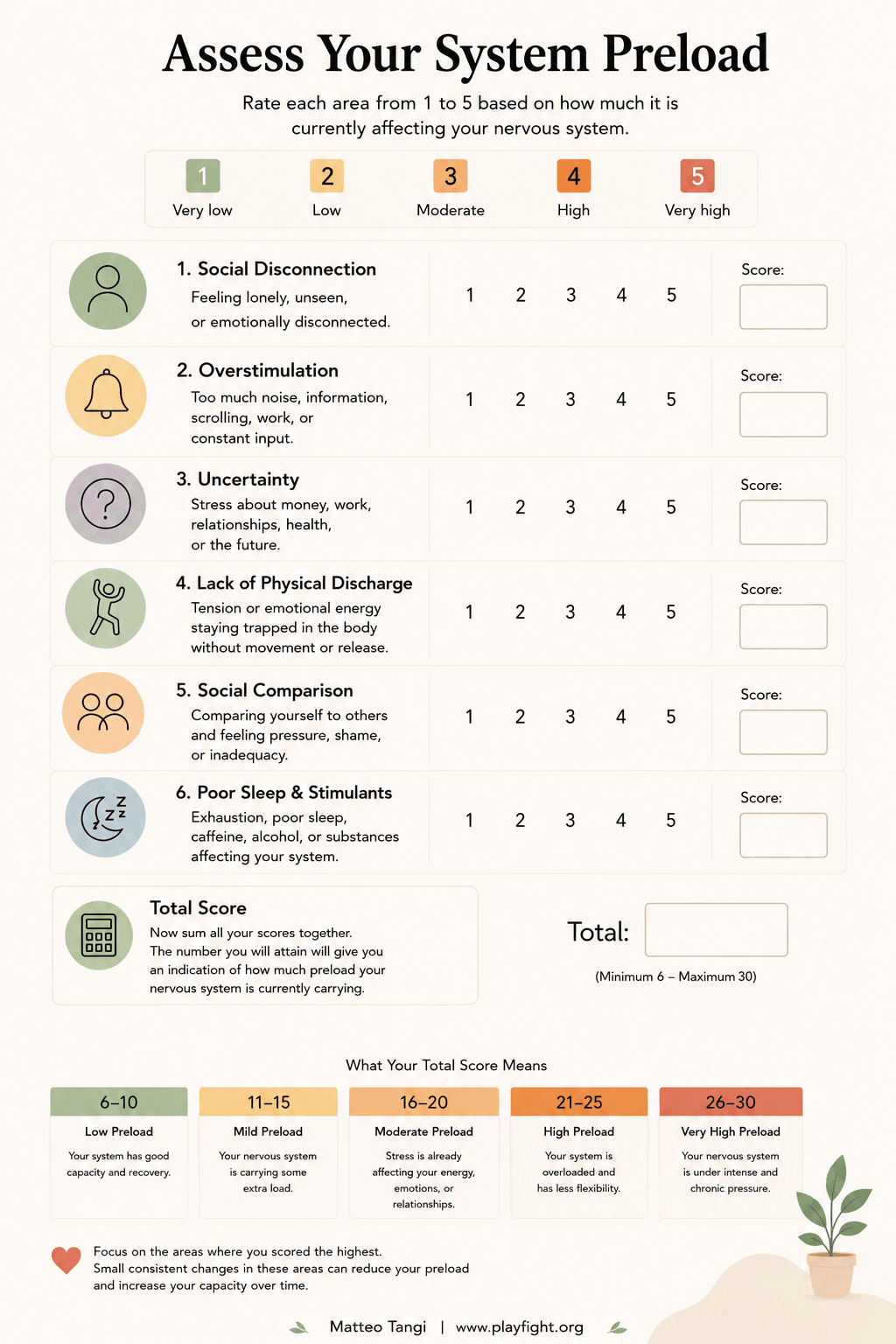
Now that you know some of the main causes of preload, I invite you to do this simple self-assessment exercise.
Its purpose is to help you recognize how much stress, tension, and activation your nervous system may already be carrying before new challenges even happen.
Sometimes we think we are weak, overly emotional, or “overreacting,” when in reality our system is simply overloaded.
In the image below, you will find 6 common sources of preload.
For each one, give yourself a score from 1 to 5 based on how much it is currently affecting you.
Then sum all the scores together.
Your final number will give you an indication of how much preload your system is carrying right now, and the areas with the highest scores will show you where your attention could create the biggest shift.
Your System Capacity
Capacity is different.
Capacity is your ability to stay connected to yourself while fear is present.
Some people have low preload but very low emotional capacity. They seem calm until something difficult happens, and then the system collapses quickly into panic, shutdown, anger, or avoidance.
Other people have high capacity. They can hold intensity, pressure, uncertainty, and confrontation for long periods of time. They appear strong and resilient, but sometimes they also normalize chronic stress and slowly burn themselves out without realizing it.
Capacity grows when we stop escaping fear and start learning how to stay with it, not forcing, not suppressing, not dramatizing, staying connected.
This is one of the deepest reasons why body-based practices for nervous system regulation can be so powerful. The body allows us to practice fear in real time. Instead of only talking about emotions, we experience activation directly while learning how to breathe, stay present, soften, move, and reconnect.
Over time, the nervous system begins to understand that intensity does not automatically mean danger. This creates more flexibility, resilience, and emotional freedom.
The 4 Types of Baselines
Like we saw above, preload + capacity creates your baseline.
Your baseline is the state from which your nervous system responds to life. It shapes how you experience stress, fear, uncertainty, conflict, intimacy, pressure, and even daily situations that may seem small from the outside.
Two people can go through the exact same experience and react in completely different ways. One person may stay grounded and connected, while another immediately goes into panic, shutdown, anger, avoidance, or overwhelm. Often this difference is not about personality or weakness. It is about how much preload the system is carrying and how much capacity is available in that moment.
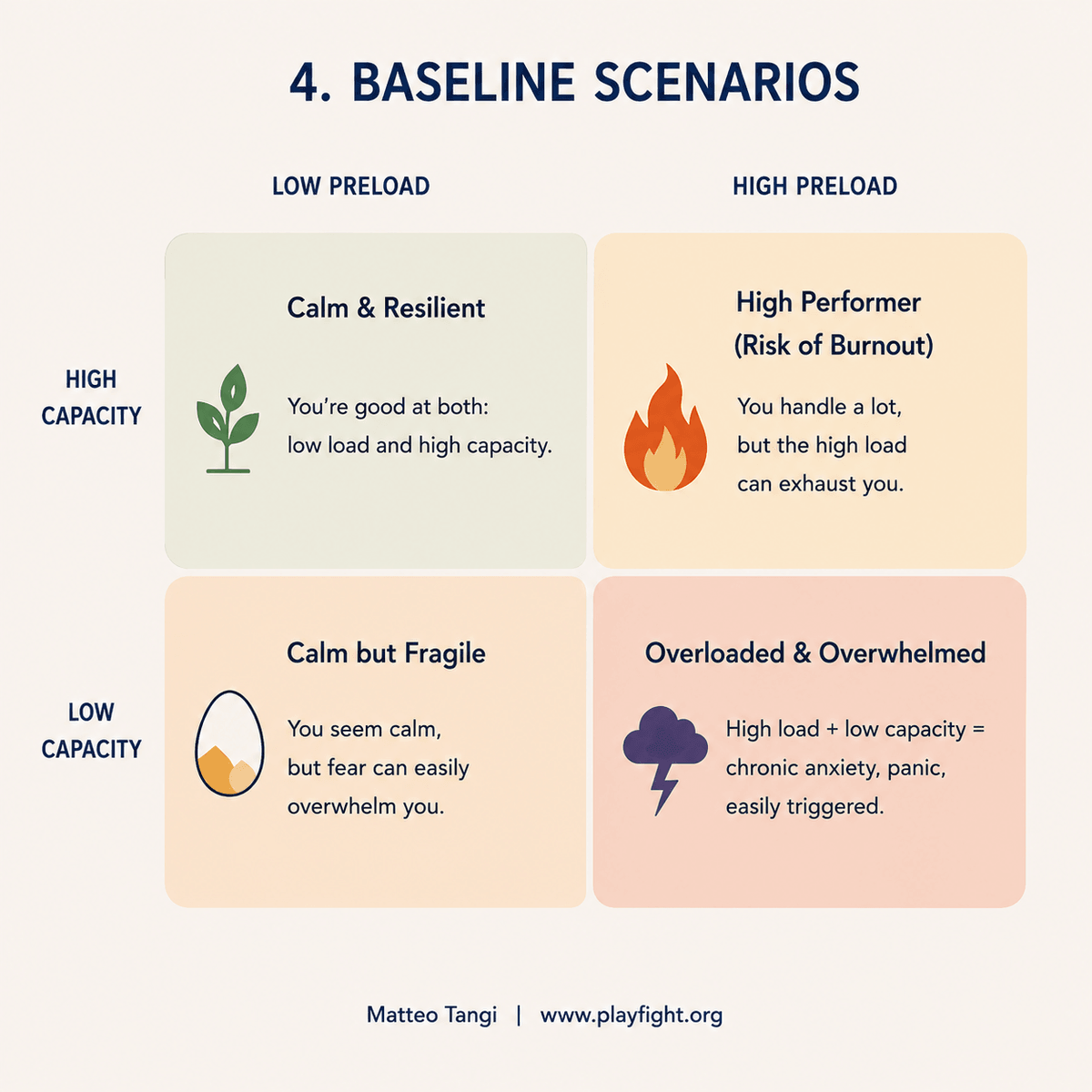
This creates four common baseline scenarios.
1. Calm & Resilient
Low preload + high capacity.
This is where we aim to be most of the time. It does not mean life is perfect or free from fear. Difficult emotions, uncertainty, conflict, and stress still exist, but the nervous system has enough space to process them without immediately collapsing into reactivity.
People in this state are usually able to stay connected to themselves while something difficult is happening. They can breathe, think clearly, feel emotions without drowning in them, and recover relatively quickly after stressful moments.
Fear may still appear, but it does not completely take over the system. There is flexibility, groundedness, and room to respond consciously instead of reacting automatically.
2. High Performer (Risk of Burnout)
High preload + high capacity.
This is where many highly functional people live. They can hold a lot of pressure, responsibility, intensity, confrontation, and uncertainty for long periods of time. From the outside they often appear strong, resilient, productive, and capable.
The challenge is that because they can handle so much, they often stop noticing how overloaded they actually are. Stress slowly becomes normalized. The nervous system remains activated for too long and the body starts adapting to chronic tension as if it were normal life.
These are the people who keep going even when exhausted, disconnected, emotionally numb, or physically depleted. Eventually the system starts paying the price through anxiety, burnout, insomnia, irritability, collapse, or loss of meaning.
3. Calm but Fragile
Low preload + low capacity.
This baseline can sometimes be confusing because externally life may appear relatively calm. There may not be huge amounts of pressure or obvious chaos happening, yet internally the nervous system has very little reserve available.
In this state even small stressors can feel disproportionately intense. A difficult conversation, criticism, uncertainty, emotional tension, or unexpected change can quickly trigger panic, shutdown, avoidance, or emotional flooding.
People here often become self-critical because they compare themselves with others and think they should be able to “handle more.” But usually the issue is not that the person is weak. The system simply lacks enough capacity in that moment to process intensity safely.
4. Overloaded & Overwhelmed
High preload + low capacity.
This is often where chronic anxiety and nervous system dysregulation become strongest. The system is carrying too much while also lacking the internal resources needed to process it.
At this stage even small situations can feel threatening because the nervous system is already overloaded. The body remains in survival mode for long periods of time and starts reacting as if danger is everywhere.
People in this state often feel constantly tense, emotionally exhausted, reactive, disconnected, hypervigilant, or unable to rest deeply. Many try to solve this by forcing themselves harder, controlling more, suppressing emotions, or becoming even more productive. But usually the system does not need more force. It needs less load, more recovery, more regulation, more support, more connection, and more safety.
Understanding your baseline changes the way you relate to yourself. Instead of asking “What’s wrong with me?”, you begin asking: “What is my nervous system carrying right now?” and “What would help me build more capacity?”
What to Do When You Feel Anxious
Fear often starts in the body before it becomes a story in the mind.
The chest tightens, the breath becomes shallow, muscles prepare for defense, and attention narrows around danger. Many people try to escape this sensation immediately by distracting themselves, overthinking, scrolling, avoiding, or trying to “fix” the feeling as fast as possible.
But often, the more we resist fear, the stronger it becomes.
Instead, try slowing down and reconnecting with the body for a few moments.
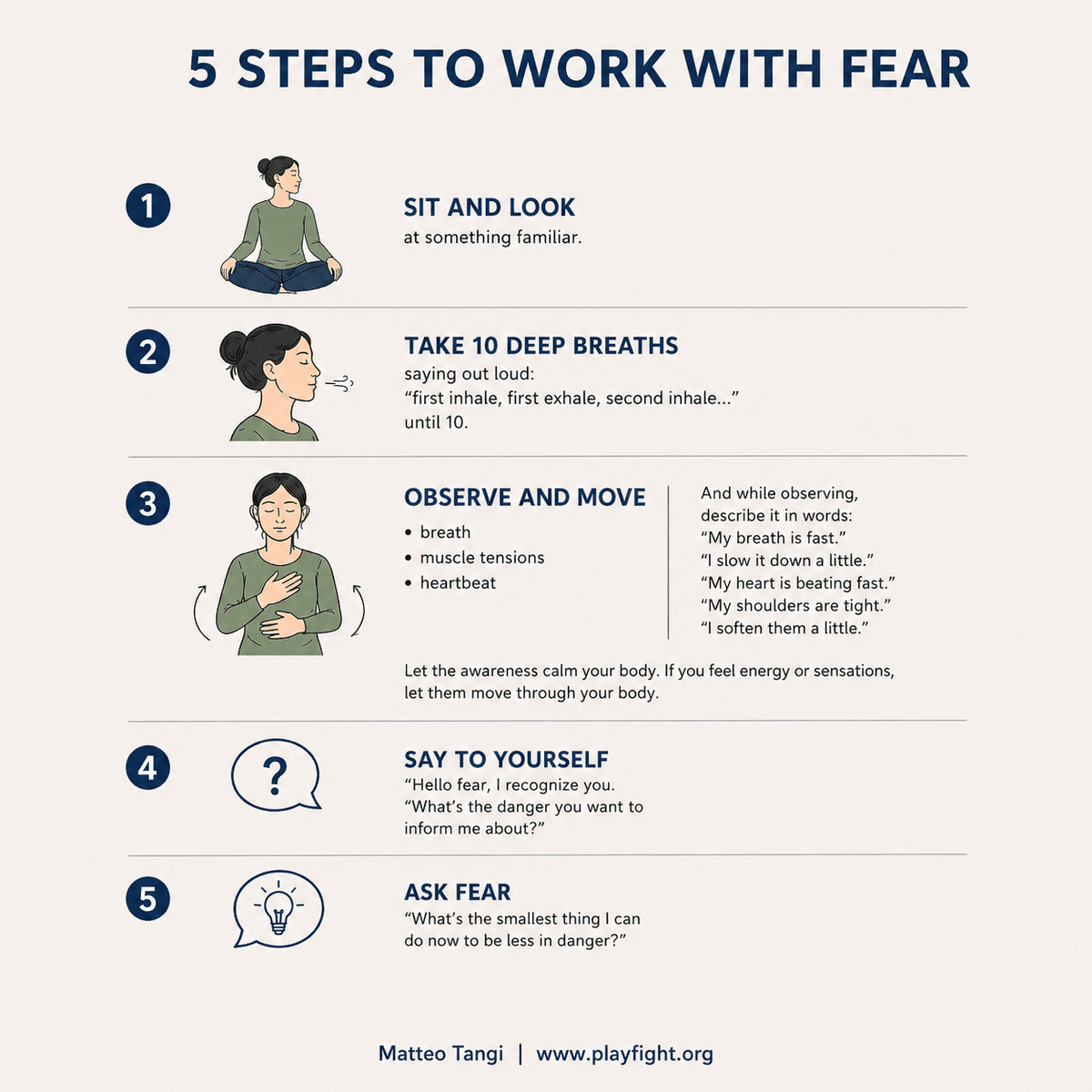
Start by sitting down and looking at something familiar around you. A wall, a plant, a cup, a window. Something simple and stable. This helps the nervous system recognize that, right now, you are here and not lost inside the mind.
Then take ten deep breaths while counting out loud:
“First inhale, first exhale...”
“Second inhale, second exhale...”
until ten.
Speaking and breathing at the same time helps interrupt the spiral of anxious thoughts and brings attention back into the present moment.
As the breath slows down, begin to observe and move.
Notice what is happening inside the body. Observe your breathing, muscle tension, heartbeat, temperature, contractions, or restlessness. And while observing, describe it in words:
“My breath is fast.”
“My chest feels tight.”
“My shoulders are tense.”
“My heart is beating quickly.”
Then allow the body to move a little. Shake your hands. Stretch your arms. Roll the shoulders. Walk slowly around the room. Breathe deeper.
The goal is not to force yourself to relax. The goal is to help the nervous system move the activation through the body instead of freezing around it. Fear is energy. When the body stays completely contracted, that energy often gets stuck and intensifies.
From there, gently acknowledge the fear instead of fighting it.
You can say to yourself:
“Hello fear, I recognize you. What danger are you trying to inform me about?”
Sometimes fear is pointing toward something meaningful. Sometimes it is exaggerating. Sometimes it is carrying old experiences into the present moment. But listening with curiosity often creates more clarity than trying to silence it immediately.
And finally ask yourself:
“What is the smallest thing I can do right now to be a little less in danger?”
Not the perfect solution. Not solving your whole life. Just one small grounded action.
Sometimes anxiety does not disappear immediately. But your relationship with it starts changing. Instead of drowning inside the wave, you begin learning how to stay connected to yourself while the wave moves through you.
This process teaches the body something important: fear can move, change, and pass when we stay present with it instead of resisting it.
What often changes is not that fear disappears, what changes is your relationship with it. You stop drowning in the wave, and start learning how to ride it.
Fear as an Ally
Remember, fear has a purpose. It wants to protect us.
But when we never learn how to work with fear, protection slowly becomes limitation. The same mechanism designed to keep us safe can begin to close us off from life, intimacy, creativity, expression, and growth.
And maybe one of the most important questions is not:
“How do I get rid of fear?”
But:
“How do I build a healthier relationship with it?”
Because courage is not the absence of fear.
Courage is staying connected while fear is present.
Real courage is the ability to remain open, grounded, and human even when uncertainty exists. It is the willingness to feel intensity without abandoning yourself.
And often, that is where transformation begins.

Over the years I’ve seen again and again that fear is not something to “fix”.
Very often it is simply a part of us asking for more support, more grounding, more connection, more capacity. And honestly, I still work with it myself.
Before difficult conversations. Before stepping into the unknown. Before sharing vulnerable parts of myself. Before standing in front of a group. Fear still comes.
But little by little, I stopped seeing it as proof that something is wrong.
Sometimes it is simply the body saying: “This matters.”
So if fear is present in your life right now, maybe the invitation is not to fight it immediately. Maybe the invitation is to get curious. To listen. To breathe. To reconnect with your body.
And to remember that courage is not becoming fearless.
It is learning how to stay connected while fear is moving through you.
About the author.
Matteo Tangi is the founder of Playfight, an embodied practice that combines movement, confrontation, play, and human connection.
For the last 15 years he has worked as a coach and facilitator exploring emotions, relationships, nervous system regulation, emotional resilience, and the wisdom of the body.
Through workshops, trainings, and immersions around the world, his work supports people in reconnecting with their strength while staying open, connected, and deeply human.
To read his story visit www.playfight.org/matteo
Here's a Graphic summary of the article content you can download and use at home: